
Have you ever been to China without walking the Great Wall?
Have you ever been to Paris and left without having a single photo taken with Eiffel Tower as a background?
Well, in Jogja, don't leave just yet when you haven't been to Borobudur! It'll be the biggest regret you bring back home when you haven't go to this UNESCO World Heritage Site.


In fact when I was making plan to Dieng Plateau, the return journey was carefully timed so I could spend many hours in Borobodur itself. So, at noon the journey back to Jogja began and I reached Borobodur at about 3pm. Phew, just enough time till the temple park close at 5.30pm.
The advantage about us (Malay) when visiting Indonesia is we don't really look much different from Indonesian don't we and with a little practice, we can converse in Bahasa Indonesia in no time too. So, Pak Mur (our driver to Dieng) advised us to get an admission ticket at local counter instead of at international counter as the prices between these two counters differ greatly. Local got to pay only IDR 15,000 while international visitor got to pay USD 15! That's a huge different isn't it?!

Saving whenever possible is of course something that I am practicing when on the road and it of course made me happy. After queuing at the local counter and saying only one word - "dua" which means two, yeah I managed to get an admission tickets for two at local price. That was quite easy! And that was quite a lot of saving too and I had already thinking of buying more souvenirs with that money saved.
Then, handing the ticket to my sister and letting her walk ahead of me towards the entrance was a huge mistake. HUGE MISTAKE! I shouldn't let her do any talking next time! We were denied from entering using the tickets I just purchased as easy as how I got the ticket at local price when my dear sister 'brilliantly' answered 'Malaysia' when the officers at the entrance asking where we are from.
Could she just answered Acheh or Kalimantan since people from these place speak Malay too or could she just say we are from other part of Indonesia since Indonesia has large population and many of them I believe still haven't been to Borobudur.
So, as you guess the saving I was calculating before cannot go to the souvenirs but to pay the remaining ticket fare for international visitors. Hmmm...there went my effort. We were escorted to the international counter and got to settle the remaining payment :(
So, as an international visitor, the special treatments you received are no other that having a free drink (coffee/tea), bottle of mineral water, air conditioned waiting area and there's lovely lady helping you to put on batik sarong. The batik sarong is compulsory for every visitor when visiting the temple compound to increase appreciation of Borobudur Temple as cultural heritage.
Although I was pretty mad at my sister for being proud Malaysian at times when we could gain some saving from the admission ticket, I didn't feel regret paying the USD 15 ticket fare as that was the least I could contribute in helping UNESCO preserving the heritage site. I do hope they use the collection from ticket admission wisely and appropriately.

So, here are some fact loaded info about Borobudur Temple.
Contrary to Prambanan Temple, Borobudur Temple is a Buddha temple. It was built between AD 750 and 842, making it 300 years older than Angkor Wat in Cambodia. It was listed as UNESCO World Heritage Site for its outstanding cultural universal value.

Borobudur was used both as shrine and also for a place for Buddhist pilgrimage. It was built in 3 tiers; being 6 square platforms as the foundation, 3 circular platforms and topped with one large monument stupa. Each platform has relief panels and Buddha statues. The narratives reliefs on the wall read from right to left and for pilgrims, their ritual journey following this direction (right to left-clockwise) circumambulating the monument ascending to the most top stupa.


However today, Borobudur is seen to be used once again as a place of worship and pilgrimage only during full moon in May or June, where Buddhist celebrate Wesak. On other day, it receives many visits from tourists like me wanting to admire the build of the ancient monument with intricate architecture that full of history.
Unfortunately for me, I didn't use a tour guide service that can explain more on the history and meaning of relief on the wall of Borobudur. It was only after I visited the Borobudur museum within the temple park I understand about all those creatures crafted on the wall. Each wall illustrated a soul's progressing phases towards redemption and episode from the life of Buddha.
The first tier named Kamadhatu describes the phenomenal world, the world inhibited by common people. So the base of the platform consists of reliefs depicted on law of cause and effect or law of Karma. It depicts the direct and indirect result of immoral acts such as theft, rape, murder etc to be torturous afterlife. Besides the immoral acts, the reliefs also depicts about good acts like working together, planned parenthood etc. So I belief every religion teaches its devotee to be a good person, never to be the otherwise.


The second tier is the transitional sphere, in which human are release from worldly matters and named as Rapadhatu. At this platforms, the walls contain about 328 Buddha statues depicted the birth of Buddha etc.


And the final tier, Arupadhatu, being the highest sphere, the abode of gods. This tier contains 3 circular platforms surrounded one large stupa (the bell shape object) representing the rising above the world. The 3 platforms contain perforated stupas that have Buddha statues in it. In total, there are 72 of these stupas.


However during my visit, the 3 top platforms were not accessible to any visitor as it was under cleaning process from the recent Mount Merapi eruption's volcanic ash.


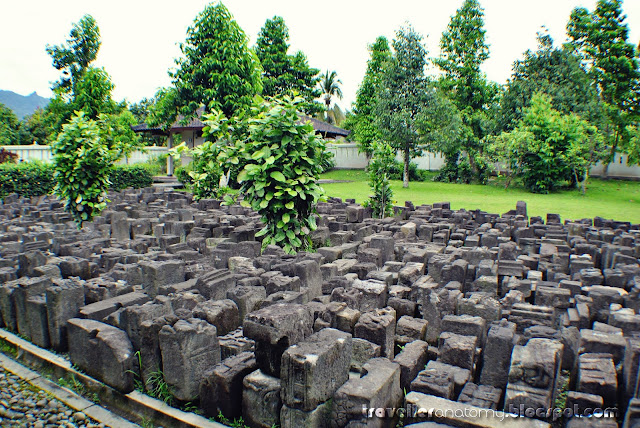
My tour in Borobudur complex ended with a visit to Borobudur museum just outside of the temple compound. A very detail information about Borobudur was provided with accompanied old photograph. A remaining stones of Borobudur are also placed outside the museum, still waiting to be restored I guess.

Since Borobudur is located about 42km from Jogja, Pak Mur was constantly reminding me that we need to leave early possibly before working hours ends to beat the traffic jam or local called it 'macet' and also because I hired him for only 12hours that his service should end at 5pm in Jogja. But since I couldn't stop being me who always takes long time at this kind of place, at 5pm I was still inside the Borobudur complex. And that was also means I didn't have time to visit Mbah Marijan's house, the spiritual gatekeeper of Mount Merapi on my way back to Jogja. Ok, I have to admit going to Dieng Plateau and Borobudur on the same day is doable but pretty hectic and like me, there is a chance you'll miss some of your planned itinerary due to time constraint.
On my way back to Jogja from Magelang (Borobudur area), as expected we had to go through the 'macet', not only because it was past working hours where everyone was rushing to go back home but also because one of the bridge on the main road was ruined by the recent cold volcanic ash flood and was closed.
Although I missed going to Mbah Marijan's house but with His will, I was able to witness the post eruption effect of Mount Merapi during the 'macet' and it was the most heart breaking scene in my life. The river flowed nothing but volcanic ash, houses were ruined and the area was deserted with volcanic ash, THICK VOLCANIC ASH. Everywhere I saw the volcanic ash.


I can't say much if those doesn't move you.
For me, I never thought that I could witness all this in front of my eyes and at so close distance. It made me somehow grateful for all the life pleasure that I had and for not having to experience such disaster in my life. Alhamdulillah.
From this trip, all He wanted me to see was His mightiness as a Creator that He can take anything from us in a split second whether we like it or not, so we as His servant need to always be humble and grateful.
So all in all, it was an amazing and meaningful day for me, starting from very early morning journey to Dieng Plateau to visiting the grandeur monument in Jogja. How I spent the day are here, here and here.

Saving whenever possible is of course something that I am practicing when on the road and it of course made me happy. After queuing at the local counter and saying only one word - "dua" which means two, yeah I managed to get an admission tickets for two at local price. That was quite easy! And that was quite a lot of saving too and I had already thinking of buying more souvenirs with that money saved.
Then, handing the ticket to my sister and letting her walk ahead of me towards the entrance was a huge mistake. HUGE MISTAKE! I shouldn't let her do any talking next time! We were denied from entering using the tickets I just purchased as easy as how I got the ticket at local price when my dear sister 'brilliantly' answered 'Malaysia' when the officers at the entrance asking where we are from.
Could she just answered Acheh or Kalimantan since people from these place speak Malay too or could she just say we are from other part of Indonesia since Indonesia has large population and many of them I believe still haven't been to Borobudur.
So, as you guess the saving I was calculating before cannot go to the souvenirs but to pay the remaining ticket fare for international visitors. Hmmm...there went my effort. We were escorted to the international counter and got to settle the remaining payment :(
So, as an international visitor, the special treatments you received are no other that having a free drink (coffee/tea), bottle of mineral water, air conditioned waiting area and there's lovely lady helping you to put on batik sarong. The batik sarong is compulsory for every visitor when visiting the temple compound to increase appreciation of Borobudur Temple as cultural heritage.
 |
| Place to wear batik sarong for local visitors |
Although I was pretty mad at my sister for being proud Malaysian at times when we could gain some saving from the admission ticket, I didn't feel regret paying the USD 15 ticket fare as that was the least I could contribute in helping UNESCO preserving the heritage site. I do hope they use the collection from ticket admission wisely and appropriately.

So, here are some fact loaded info about Borobudur Temple.
Contrary to Prambanan Temple, Borobudur Temple is a Buddha temple. It was built between AD 750 and 842, making it 300 years older than Angkor Wat in Cambodia. It was listed as UNESCO World Heritage Site for its outstanding cultural universal value.

Borobudur was used both as shrine and also for a place for Buddhist pilgrimage. It was built in 3 tiers; being 6 square platforms as the foundation, 3 circular platforms and topped with one large monument stupa. Each platform has relief panels and Buddha statues. The narratives reliefs on the wall read from right to left and for pilgrims, their ritual journey following this direction (right to left-clockwise) circumambulating the monument ascending to the most top stupa.


However today, Borobudur is seen to be used once again as a place of worship and pilgrimage only during full moon in May or June, where Buddhist celebrate Wesak. On other day, it receives many visits from tourists like me wanting to admire the build of the ancient monument with intricate architecture that full of history.
Unfortunately for me, I didn't use a tour guide service that can explain more on the history and meaning of relief on the wall of Borobudur. It was only after I visited the Borobudur museum within the temple park I understand about all those creatures crafted on the wall. Each wall illustrated a soul's progressing phases towards redemption and episode from the life of Buddha.
The first tier named Kamadhatu describes the phenomenal world, the world inhibited by common people. So the base of the platform consists of reliefs depicted on law of cause and effect or law of Karma. It depicts the direct and indirect result of immoral acts such as theft, rape, murder etc to be torturous afterlife. Besides the immoral acts, the reliefs also depicts about good acts like working together, planned parenthood etc. So I belief every religion teaches its devotee to be a good person, never to be the otherwise.


The second tier is the transitional sphere, in which human are release from worldly matters and named as Rapadhatu. At this platforms, the walls contain about 328 Buddha statues depicted the birth of Buddha etc.


And the final tier, Arupadhatu, being the highest sphere, the abode of gods. This tier contains 3 circular platforms surrounded one large stupa (the bell shape object) representing the rising above the world. The 3 platforms contain perforated stupas that have Buddha statues in it. In total, there are 72 of these stupas.


However during my visit, the 3 top platforms were not accessible to any visitor as it was under cleaning process from the recent Mount Merapi eruption's volcanic ash.

 |
| The furthest platform I could go |
 |
| Cleaning in progress |

 |
| The volcanic ash collected from the temple |

My tour in Borobudur complex ended with a visit to Borobudur museum just outside of the temple compound. A very detail information about Borobudur was provided with accompanied old photograph. A remaining stones of Borobudur are also placed outside the museum, still waiting to be restored I guess.


 |
| Yay! Another tick to my UNESCO World Heritage Site |
Since Borobudur is located about 42km from Jogja, Pak Mur was constantly reminding me that we need to leave early possibly before working hours ends to beat the traffic jam or local called it 'macet' and also because I hired him for only 12hours that his service should end at 5pm in Jogja. But since I couldn't stop being me who always takes long time at this kind of place, at 5pm I was still inside the Borobudur complex. And that was also means I didn't have time to visit Mbah Marijan's house, the spiritual gatekeeper of Mount Merapi on my way back to Jogja. Ok, I have to admit going to Dieng Plateau and Borobudur on the same day is doable but pretty hectic and like me, there is a chance you'll miss some of your planned itinerary due to time constraint.
 |
| 'macet' |
On my way back to Jogja from Magelang (Borobudur area), as expected we had to go through the 'macet', not only because it was past working hours where everyone was rushing to go back home but also because one of the bridge on the main road was ruined by the recent cold volcanic ash flood and was closed.
Although I missed going to Mbah Marijan's house but with His will, I was able to witness the post eruption effect of Mount Merapi during the 'macet' and it was the most heart breaking scene in my life. The river flowed nothing but volcanic ash, houses were ruined and the area was deserted with volcanic ash, THICK VOLCANIC ASH. Everywhere I saw the volcanic ash.


I can't say much if those doesn't move you.
For me, I never thought that I could witness all this in front of my eyes and at so close distance. It made me somehow grateful for all the life pleasure that I had and for not having to experience such disaster in my life. Alhamdulillah.
From this trip, all He wanted me to see was His mightiness as a Creator that He can take anything from us in a split second whether we like it or not, so we as His servant need to always be humble and grateful.
So all in all, it was an amazing and meaningful day for me, starting from very early morning journey to Dieng Plateau to visiting the grandeur monument in Jogja. How I spent the day are here, here and here.


