After too many of temple visiting (Prambanan, Sewu & Ratu Boko) and walking on my first day (oh it's only first day, please u guys bear with me until I completed writing this whole Java trip ok), the second day seen me doing nothing matching my plan. Sometimes I don't like being too spontanious in my decision making but with much persuasion and recommendation from my host, Lisa, I agreed to rent a car and began my journey at 5 IN THE MORNING local time! How I spent the night before is here, in case u want to know how wonderful it was to me.
Why can't I wait till sunrise to start my journey?
Well, first reason because the place is far from Jogja, 116 km drive here is not equivalent the time taken when driving using PLUS highway, that you have to keep in mind.
Second, it's not only far but also on a highland which thick mist will cover all the masterpieces by afternoon. So, I need to reach there when it's still morning.
Third, late departure time will lead to late arrival in Jogja later which also means traffic jam and thinning my chances to visit another UNESCO Heritage Site.
So, where exactly was I going?
It's Dieng Plateau.
As far as our geography knowledge is concern, Indonesia is located inside Pacific Ring of Fire thus it dominated by volcanoes. Besides crater, plateau is another one of earth form produced by volcanic activity.
Dieng is derived from Sanskrit language of 'Di-hyang' (Abode of the Gods) while in Javanese language it's derived from 'edi' which means beautiful and 'aeng' which means strange.
Sitting at 2000 meters above sea level, Dieng Plateau is far from major population centre and the nearest town is Wonosobo. Wonosobo is in fact the main gateway to Dieng Plateau. You could either stay overnight in Wonosobo then proceed the next day for another hour to reach Dieng or do as what I did - leave Jogja very early morning :)
The only memory of Wonosobo I have is this place.
Where I had my breakfast after sleeping few hours on the road. Look at the pricelist, SUPER CHEAP compared to Jogja!
Since it was still quite early and my head was heavy from lack of sleep last night, I asked the driver to stop at any restaurant that was open for breakfast. I totally forgot about culinary icon in Wonosobo - Mie Ongklok. Please, please, please when u are in Wonosobo, try eat Mie Ongklok and tell me how it taste ok.
Instead, this is what I had for breakfast.
Nasi Gundul Daging Sapi.
If you been following my twitter, you had heard about this dish.
How did it taste u ask?
Well, now u see.
Now u don't :D
Honestly, it was so good I could order for second plate if I want to. It tasted like beef stew cooked with oriental spices - just the way I like it. There were also other condiments u could add to match your tasting preference.
And this is what my sister ordered for her breakfast - Bakso with giant meatballs.
Thanks Rejo Bejo for great Wonosono breakfast!
The route up to Dieng was stunning. The terraced fields of fertile soil were planted with vegetables - potatoes, spring onion and cabbage occupying the view before your eyes.
U could see the mist already covering up part of the hill.
Lovely isn't it?
Dieng Plateau is a big area with so many tourist attractions mostly on nature and culture.
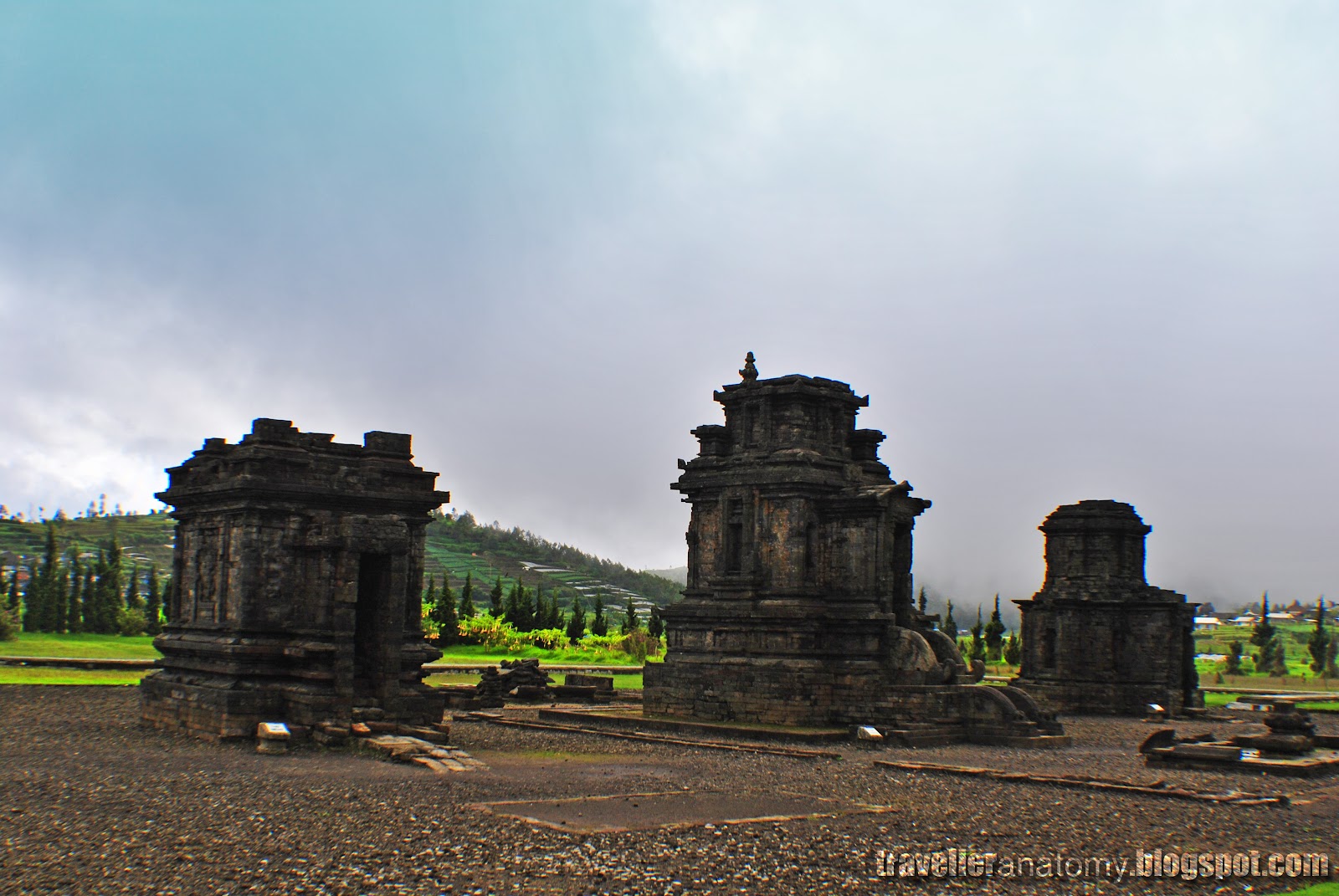
My first stop was Candi Arjuna Complex.
The moment I stepped out from the car, the very first word blurted out was "Sejukkkkk" which means cold. Wearing a thin cotton shirt was the unwisest decision I made. How could I forgot that I was going to cooler place and the temperature nothing like when I was in Prambanan the previous day. Huh, sometimes my mind refuse to work properly :p
Mmmm...no wonder this uncle wears a jacket :D
I paid no heed to the temperature and continued walking towards the entrance.
So, welcome to Candi Arjuna Complex!
Albeit named complex, the area is relatively small compared to Prambanan Temple or even Sewu Temple. There are only 5 temples remain from 19 temples built in the olden days lined next to each other.
The main one, Candi Arjuna is sit opposite to cuboid shape Candi Semar.
The other 3 are Candi Srikandi, Candi Sembadra and Candi Puntadewa.
Being here, I could agree with Javanese derivation of Dieng - 'edi-aeng' which means beautiful and quaint place.
I wish there is a cafe at this area so I could sit and sip my hot tea while looking at this incessantly beautiful scenery. Don't u agree?

Despite not as popular as other temples across Prambanan plain, I purchased a Prambanan-Boko package ticket for USD20 to visit Ratu Boko. The package entitled me to visit Prambanan temple object, Ratu Boko temple object, free transport to Boko and free audio visual.
Ratu Boko is situated about 3 km south of Prambanan Temple Complex and 200 meters above sea level. The uphill route requires you to engage in a suitable transportation, walking there is definitely the least attractive option. With Prambanan-Boko package ticket, a van is use to transport you to Ratu Boko and back to Prambanan at agreed time.
Arriving at Ratu Boko, rain started pouring down forcing myself to pull out my raincoat and styling it while visiting the area.
There's so little story I heard about Ratu Boko except the panoramic view of Prambanan Temple with Mount Merapi as a background ones able to see at small pavilion near the entrance. So, I decided to check the pavilion first before proceeding to other place.
Being on a high land looking down at a low land creates a superior feeling but you simultaneously dwarfed by the breathtakingly beautiful scenery created by Him. It's epic! This picture would be perfect on a bright sunny day where clouds don't hide the majestic Mount Merapi. Nevertheless, it was still beautiful. It's also a perfect place to admire sunset in Yogyakarta!
If you're not amaze by photo above, what about this? Didn't I tell you how amazing the scenery on a perfect day?
The site of 16 hectares is full of mystery. Unlike Prambanan and Sewu, Ratu Boko is not a remains of temple but of palace - known to modern Javanese as Kraton Ratu Boko. It is clearly seen from remnants of fortified walls and dry moat as defensive structure found in the complex. Settlement site, audience hall, women's quarter, crematorium and bathing place in the vicinity also evidence this place was not use for religion purposes. However, the precise function is still unknown.
This massive site possess three terraces with each terrace is separated by a stone gateway. The largest gateway having 5 doors separating the second terrace and the third terrace where many archeological remains found.
Paseban (reception pavilion) - a waiting room for guests who want to meet the king. Only the base stone is still remain since the pillars, walls and roof were made from wood had decayed.
Pendopo (audience hall) - a square enclosure with stone wall surrounding it.
Inside, there's a stone base formed by two separated terraces.
As the rain getting heavier, I didn't want to take the risk proceeding to the next object and get stranded somewhere inside this complex when I already made a promise to the van driver to return in 1 hour. To cover the whole Ratu Boko complex site, you'll simply need 2 hours as it's huge and the location of one archaeological site to another is quite a distance.
And each get separated by lush green nature.
It was so serene and peaceful like you're in kampung.
And I secretly believe that some place in this site still regard as sacred by some people and some ritual is still practiced. What would come to your mind when you passed by a beautiful lady in a complete traditional Javanese attire walking gracefully barefoot with her hand in dance position?
@travelleranatomy.blogspot.com